At a recent writing conference, an aspiring author asked literary agent, Heidi Gordon, about current market trends. After giving the initial caveats, she answered:
“Everyone loves mash-ups right now.”
She rattled off some intentionally ridiculous examples that got laughs from the room. Then she shared examples of books actually finding readers today. Stories that blended genres. Stories that combined familiar elements in unexpected ways. Stories that took readers someplace surprising.
The more I thought about her comment, the more I realized this trend isn’t limited to books. It’s everywhere.
A few days later, I was listening to one of my Spotify playlists and suddenly noticed that many of my favorite songs follow the exact same principle. Honestly? I think there’s a reason it works.
People need an entry point. Something familiar.
We also love that ticklish twist that makes us stop and think: “Wait… how does that work?”
Then curiosity kicks in.
And curiosity is powerful.
Mash-Ups
A mash-up combines ideas that don’t seem like they belong together.
Sometimes the concept alone is enough to grab your attention.
I love classical music. Part of that comes from playing viola throughout middle school and high school. But I’ve also realized that many of the pieces I love most aren’t strictly classical at all.
I love classical music mixed with modern styles, like Babatunde’s Hiphopera. (My favorite is his rendition of Figaro.) I love modern pop songs transformed into sweeping orchestral arrangements like the music featured throughout Bridgerton. I have Disney songs from The Little Mermaid, Mulan, and Encanto performed as punk rock and heavy metal anthems on my playlists.
In every case, the audience already knows half the equation.
The novelty comes from the other half.
Books work the same way.
Many of my favorite blurbs boil down to:
It’s like this… but with that.
A fairy tale, but in space.
A mystery, but with dragons.
A Western, but with robots.
The familiar provides the entry point. The unexpected creates the curiosity.
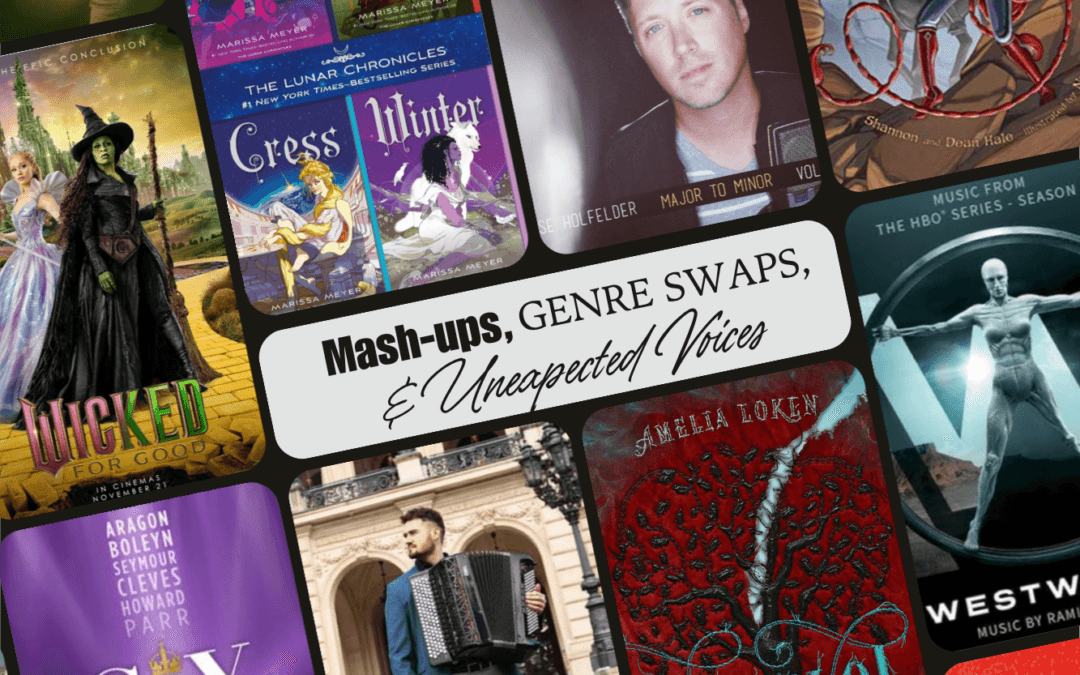
One of my favorite book examples is The Lunar Chronicles series by Marissa Meyer. These stories aren’t simple fairy-tale retellings. They mash fairy tales together with science fiction. Cinderella becomes a cyborg mechanic. Rapunzel lives on a satellite. Little Red Riding Hood carries a very different set of survival skills than her original counterpart.
Readers recognize the bones of the fairy tales, but they don’t know exactly where the story is headed.
That’s the sweet spot.
Even one of Broadway’s biggest hits follows this formula. Hamilton asks a question nobody knew they wanted answered:
What happens when you tell the story of America’s Founding Fathers through hip-hop, rap, R&B, and musical theater?
Apparently, quite a lot. (And I finally got to see it live with excellent seats overlooking skilled ASL interpreters this past spring in Chicago. No words to describe all the skill manifested in that room.)
My own novel, UNRAVEL, fits this category too.
At its heart, it’s a classic fantasy premise. A princess must save her kingdom from her evil uncle. You’ve probably heard some version of that story before.
But my princess is deaf.
Her magic isn’t flashy or destructive. She does embroidery. Not exactly the sort of ability most fantasy villains lose sleep over.
The story asks a simple question: What happens when the person everyone underestimates becomes the one who has to save the kingdom?
That’s the mash-up.
Traditional fantasy mixed with disability representation, unconventional magic, and a heroine forced to solve problems in ways nobody expects.
Genre Swaps
Sometimes creators keep the core idea but change the lens.
The story, song, or premise remains recognizable, yet the experience feels completely different.
One of my favorite examples is Ramin Djawadi’s version of Paint It Black for Westworld.
The Rolling Stones original is iconic. But transformed into a sweeping Western-style orchestral piece, it feels entirely different. Somehow, it’s still Paint It Black and not Paint It Black at the same time.
I’ve fallen down many similar musical rabbit holes.
One of my favorites is Chase Holfelder’s “Major to Minor” series. He takes songs that are familiar, upbeat, and comforting, then changes the musical mode.
The lyrics don’t change.
The melody barely changes.
The emotional experience changes completely.
Songs that once felt hopeful begin to feel sinister. Songs that once felt patriotic begin to feel authoritarian. The result is fascinating because we’re hearing something familiar through a different lens.
Stories do this too.
Consider Hadestown.
The musical retells the ancient Greek myth of Orpheus and Eurydice, but it filters that story through folk music, jazz influences, industrial imagery, and Depression-era aesthetics. The myth is ancient. The presentation feels fresh.
Or take Clueless.
At first glance, it’s a 1990s teen comedy about a wealthy high-school student navigating friendship, fashion, and romance. Look closer and you’ll find Jane Austen’s Emma wearing designer clothes and driving around Beverly Hills.
Genre swaps remind us that many stories are more flexible than we realize.
Sometimes all it takes is changing the lens.
Unexpected Voices
This may be my favorite category. In my Spotify playlist, I find this displayed with gorgeous pieces played by accordionist, Sergey Sadavoy. You don’t expect to be amazed listening to a guy playing a squeeze-box, but the man is skilled.
Sometimes the surprise isn’t the premise.
Sometimes it isn’t the genre.
Sometimes it’s the narrator.
Sometimes it’s deciding whose story deserves to be told.
The obvious example is Wicked.
Nobody expected audiences to fall in love with the Wicked Witch of the West.
Yet once she becomes the protagonist, everything changes. The villain becomes human. The familiar story becomes unfamiliar.
Broadway’s Six does something similar.
History books tend to focus on King Henry VIII.
Six asks a different question: What if we let his six wives tell the story instead?
By transforming them into a modern rock concert and letting each woman claim her own narrative, the musical shifts our attention away from the king and toward people who are often treated as footnotes. (I also watched this show recently and it knocked my socks off. So good!)
I love stories like this because they ask:
Whose perspective have we ignored?
That question shapes a lot of my own writing.
The science fiction project I’m working on right now follows a group of teenagers who become disabled after faulty cryo-sleep technology causes permanent damage. In another story, these characters might exist to motivate someone else.
They might be casualties. A cautionary tale. The sad part of the story. The people who die so someone else can become a hero. The reason a captain vows to make it better for the remaining survivors.
My characters never got that memo.
They resist. They get into trouble. They get punished.
They’re sent to the surface of an alien moon, specifically to mining sectors outside the Safe Zones. And instead of quietly disappearing from the story, they become the story.
They’re deaf.
They’re disabled.
They’re resourceful.
They’re stubborn.
They refuse to quit.
They fight for each other.
They build community.
They learn how to survive.
And eventually, they learn how to thrive.
That’s why unexpected voices matter.
Not because they’re unusual. Because they reveal stories that might otherwise go untold.
Why We Love Them
At first glance, mash-ups, genre swaps, and unexpected voices sound like different storytelling techniques.
But I think they’re all powered by the same engine.
Curiosity.
Mash-ups ask:
What happens if we combine these things?
Genre swaps ask:
What happens if we view this through a different lens?
Unexpected voices ask:
What happens if someone else gets the microphone?
The familiar gives us confidence.
The unexpected makes us lean forward.
Whether it’s a long-dead rock divas trashing Henry VIII, a fairy tale retold as science fiction, a princess with embroidery magic, or a group of disabled teens refusing to become someone else’s inspiration, the same principle applies.
We recognize enough to understand the invitation. But not enough to know what’s coming next.
And that’s often where the magic happens.
I’m convinced the literary agent was right. Maybe everyone does love mash-ups right now. Or maybe what readers really love is the moment they encounter an idea and think:
“Wait… how did they make THAT work?”
And then they have to keep reading to find out.
To wrap up this week’s post, I have a Baker’s Dozen of mash-up and genre-swap songs to add to our playlist! Enjoy!
The Four Seasons – Vivaldi as performed by Sergey Sadoyvoy (accordion)
Largo (Figaro) – Babatunde HipHopera (My favorite of all of his songs)
Every Breathe You Take – Chase Holfelder (Major to minor – creepy)
I Think We’re Alone Now – Hidden Citizens (creepy and ominous)
Paint it Black – Ramin Djawadi (West World soundtrack)
The Battle of New Orleans – Nitty Gritty Dirt Band (very different from the mid-century history lesson song)
Ex-Wives – SIX the musical (Greensleeves is in the background)
Guns and Ships – Hamilton the musical
Wait for Me – Hadestown the musical
Thunder – Thomas Mercier, Theo Croix (Bridgerton soundtrack)
Royals – Steve Horner (strings and percussion)
What is Love? – Cornelius Link (Medieval style)
Kiss the Girl – Stellar Kart (or Kimmi Smiles or Chase Holfelder)