
Innocence or Ignorance?
Early in my writing journey, nearly eighteen years ago, I didn’t have a road map. I had a story I loved, a stack of library books, and the kind of earnest determination that makes you believe you can figure out anything if you squint hard enough. I hadn’t read any writing craft books. I didn’t know what a beat sheet was. I didn’t know how scenes worked. I didn’t know that “character arc” meant more than “make sure they kiss at the end.”
I also didn’t know – and this is the part that still makes me groan – that in in the Year of our Lord 2012, when a junior editor at Candlewick Press invites you to send your manuscript, you’re supposed to email it, not use the postal service.
Mistakes are Good Teachers
Unfortunately, I had read enough stories about 20th century authors sending off their manuscripts that I naturally believed manuscripts traveled the world wrapped in brown paper and twine. (This list includes Flannery O’Connor, Sylvia Plath, Ray Bradbury, and Stephen King. This is a fun historical film about mail delivery from the 1950s.) So, after my first writer’s conference, when I’d intrigued that junior editor enough that she gave me her business card and invited me to send her my manuscript, that’s what I did. I printed all 300 pages, wrapped them like a parcel from a Dickens tale, taped it within an inch of its life, and mailed it off to San Francisco. I never heard back. I honestly can’t blame her. Somewhere in California, there’s probably still a mysterious brick‑shaped package with my name on it.
Experts are Better Teachers
But that moment – that sweet, misguided confidence – is partly why I am excited to be working on my own writing craft book. These craft books became my teachers long before I had a writing community. They helped me understand story shape, character interiority, emotional resonance, and eventually, how to trust my own voice.
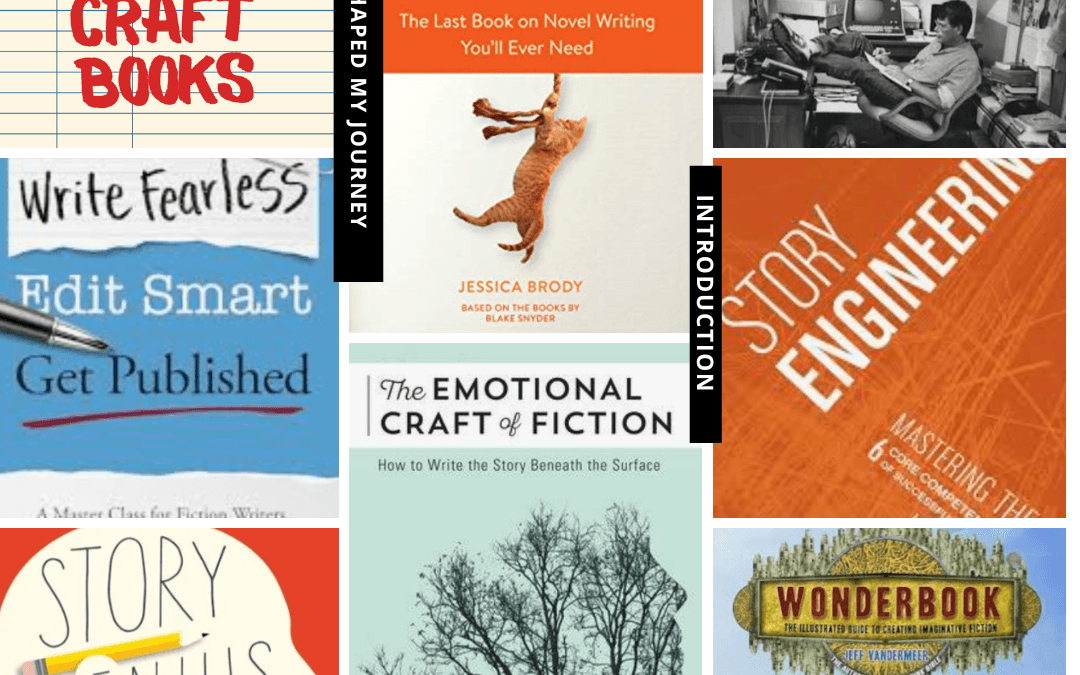
Next month, I’m starting a new series: Writing Craft Books that Shaped my Journey, a walk through the writing books that helped me become the storyteller I am today. These are one part review and one part reflection: what each book taught me, the tools I gained, and how those tools helped me grow.
Here’s the path we’ll take together:
- Save the Cat by Blake Snyder— the first time story structure finally made sense
- Save the Cat Writes a Novel by Jessica Brody— the moment structure met character
- On Writing by Stephen King — the craft‑memoir that taught me honesty and discipline
- Story Engineering by Larry Brooks — the deep dive into story physics
- Story Genius by Lisa Cron — where I learned that misbelief drives everything
- Wonderbook by Jeff VanderMeer — the wild, visual permission slip to break the rules once you’ve learned them
- The Emotional Craft of Fiction by Donald Maass — how to make readers feel without forcing it
- Write Fearless, Edit Smart, Get Published by Lisa Mangum — the book that helped me trust my voice and write with courage
We Will Explore Together…
- What a new(ish) writer can learn from the book
- The tools I gained from reading it
- How it re-framed or polished my writing skills
- Who I’d recommend it to (and why)
If you’re a writer who loves learning, or someone who’s still figuring out where to begin, I hope this series feels like a cool glass of lemonade and a seat at the table. Writing craft books don’t replace community, but they can be companions — steady, surprising, and sometimes exactly what you need at the right moment.
And if you’ve ever mailed a manuscript wrapped in brown paper because you didn’t know any better, welcome. You’re in good company.
To celebrate my innocence and ignorance at the beginning of my writing journey, let’s add a few fun songs to our Playlist:
Please Mr. Postman by the Marvelettes (though the Carpenters and the Beatles each did versions)
Signed, Sealed, Delivered by Stevie Wonder – a great song when searching for the right literary agent or editor
The Letter by the Box Tops – I remember dancing to this song with my Daddy when I was little.