
For my first five years as a writer, I focused almost entirely on mastering the craft of prose. After joining SCBWI, I was invited into a critique group made up of an eclectic mix of picture book creators, middle grade authors, and YA novelists. The mentors in that room transformed my understanding of writing craft. Under their guidance, I learned how to build stronger sentences, create immersive atmosphere, sharpen chapter endings, and craft seamless transitions. But while I was becoming a better writer at the sentence level, I was missing something much bigger: story structure.
I was learning interior design when I really needed architecture.
Like many discovery writers, I believed that if I followed the story long enough, the structure would eventually reveal itself. Using that approach, I spent years drafting an ambitious fairy tale retelling that eventually ballooned to nearly 200,000 words. Every scene felt rich. Chapters flowed naturally. The manuscript looked impressive from the inside.
But I had built a sprawling literary estate without ever consulting a blueprint.
The Functional Arch: When a Sprawling Castle Meets Story Engineering
When a few novelists in our group brought Larry Brooks’s Story Engineering to the table, I jumped into the buddy read. As we parsed through the mechanics of the four-part structure, a cold, gut-wrenching feeling settled into my chest. I looked back at my 200,000-word masterpiece. This new perspective helped me understand the concept of functional architecture.
We talk about the classic arch in design because it’s beautiful, but its true genius is physics. It exists to distribute massive amounts of weight so the ceiling doesn’t cave in. My critique group had helped me craft a magnificent, sprawling castle—but its foundation was completely crumbling under its own immense weight.
I wasn’t ready to tear down my castle right away. Instead, I used our monthly critiques as a training ground. As a circle, we adopted Brooks’s terminology and began talking about our manuscripts like structural engineers. We stopped giving vague notes on pacing and started mapping out milestone metrics. Suddenly, we could look at a chapter and see that a major incident occurred way too late to function as a proper Midpoint.
It’s always easier to spot a shifting foundation in someone else’s house. I developed my understanding of story structure by applying these concepts to critiques of my peers’ work. But the more I trained my eyes to see the engineering strengths and weaknesses in their pages, the more I was forced to look back at my own.
Even then, I went into deep structural denial. For months, I wrestled that manuscript. I tried to perform emergency renovations. What if I split it up and turned it into a trilogy? What if I gutted a few subplots and tore down a couple of side characters?
But you can’t fix a crumbling foundation by rearranging the furniture or ripping out a few closets. No matter how many cosmetic changes I tried to make, the math didn’t work. I arrived at the ultimate crossroads every writer dreads: I either had to completely demolish the entire thing and rebuild it from the ground up, or put it in a drawer and start fresh on something else.
I couldn’t quite bring myself to put it away until the first seeds of UNRAVEL started sprouting in my imagination.
Stepping into a brand-new project with a toolkit you barely know how to use is terrifying. I want to be entirely transparent here: Story Engineering did not suddenly turn me into a master architect overnight. When I began drafting UNRAVEL, I still struggled immensely with plot, structure, and character agency—ensuring my protagonist was actively driving the story forward rather than just letting things happen to her. I was like an apprentice builder holding heavy power tools for the first time, wielding them with massive awkwardness and inefficiency.
But for the first time in my writing life, I had the tools.
What New Writers Can Learn From These Books
Writers love to debate the “rivalry” between discovery writing (pantsing) and planning (plotting), but the truth is that both methodologies are necessary. Every author has to figure out where they sit on the spectrum:
- The Pure Discovery Writer: Dreams and discovers a wild first draft, then uses structure to prune, trim, and shape the chaos later.
- The Hybrid Writer: Erects a few strong “tent poles” to hold up the sky, fabricating the details around and between them.
- The Structural Planner: Thrives with a complete blueprint and clear engineering parameters from day one.
Story Engineering isn’t a cage meant to lock out your intuition. Whether you pick it up before you type word one, or use it at the end to diagnose a messy draft, it teaches writers that structure is simply a tool of story physics.
Through this journey, I discovered exactly where I fit. I realized that my own creativity and efficiency thrive best when I have more structure at the very beginning of the process. Without those initial guardrails, I get so attached to the sprawling world I’ve built that I can never bring myself to “kill my darlings.”
The Tools I Gained From Reading Them
The most valuable takeaway from Story Engineering is the blueprint of the Six Core Competencies, which forces you to look at a book macroscopically:
- Concept: The core “What if?” question that transforms an idea into a high-stakes hook.
- Character: Crafting three-dimensional personas who reveal their true self under pressure.
- Theme: The underlying message, heart, and emotional resonance of the story.
- Structure: The four-part framework that sequences dramatic tension.
- Scene Execution: Writing tight scenes that carry specific narrative goals.
- Writing Voice: The specific stylistic delivery and tone that connects with the reader.
Additionally, Brooks’s layout of the four-part milestones (the Setup, the Response, the Attack, and the Resolution) provided an objective, emotion-free language that my critique group could use to diagnose big-picture issues accurately. Larry Brooks gave me the blueprint I needed to ensure that when I finally built the world of UNRAVEL, it would stand on a foundation solid enough to hold up the dream.
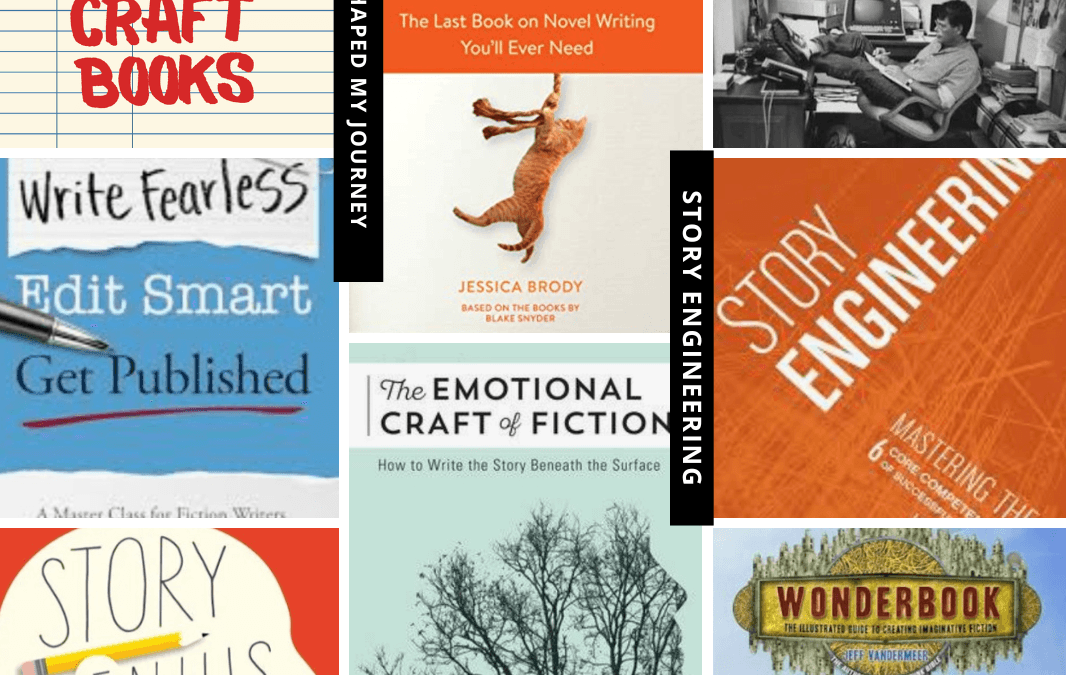
‘Writing Craft Books That Shaped My Journey‘ is an ongoing series exploring the books that helped me grow from an aspiring writer into a working storyteller. Each post examines one book, the lessons it taught me, and where it fits in a writer’s development. You can find earlier posts on ‘Save the Cat’ here and Stephen King’s ‘On Writing”, here.