
By the time I picked up Wonderbook by Jeff VanderMeer, I had become a devoted student of writing craft.
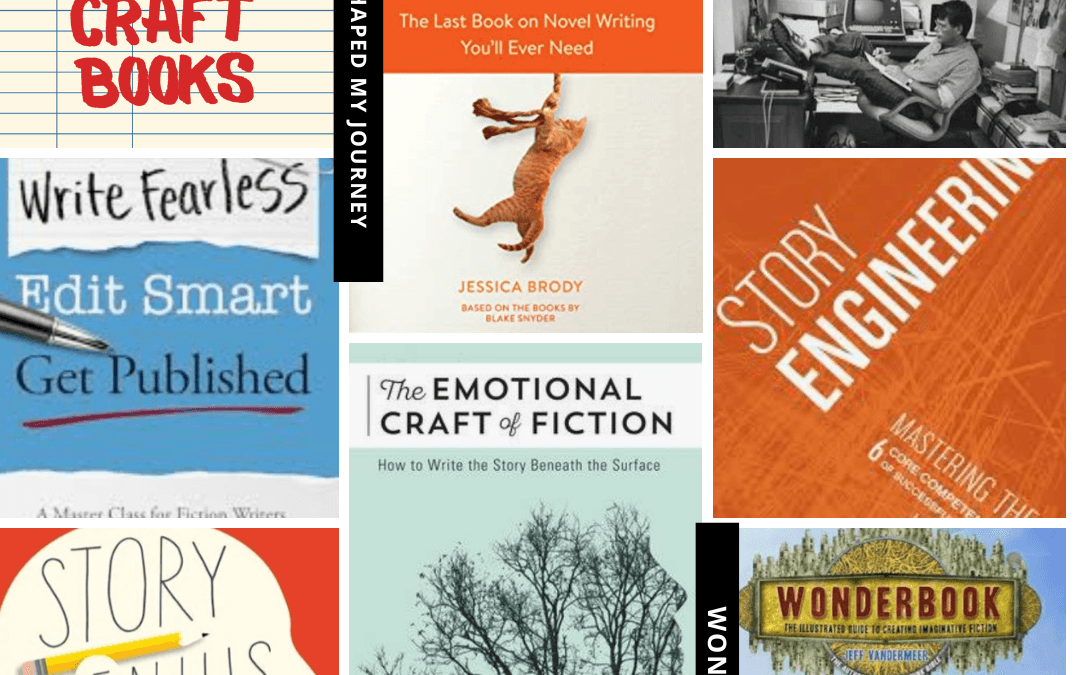
I’d spent years learning about structure, pacing, character arcs, plot points, and story milestones. Books like Story Engineering, Save the Cat!, and Story Genius gave me frameworks I could study, discuss, and apply. Each one helped me understand writing as both an art and a discipline.
Then, while wandering through a bookstore while attending a writing conference, I stumbled across a writing craft book that looked completely unlike anything else on the shelf.
Wonderbook was massive, colorful, and stuffed with illustrations. It felt less like a writing craft book and more like someone had bound together an artist’s sketchbook, a field guide, and a dream journal. As a visual person, I was instantly intrigued.
At the time, I was wrestling with the magic system in UNRAVEL. I wanted to build something that felt fresh rather than derivative of every fantasy novel, movie, and video game I’d consumed throughout my life. When I flipped through Wonderbook, it looked like exactly what I needed.
It was not.
Or at least, not in the way I expected a writing craft book to behave.
Falling Down the Rabbit Hole
Most writing craft books feel like maps. Wonderbook felt like wandering into Willy Wonka’s chocolate factory.
Every time I thought I understood where a chapter was going, it swerved somewhere unexpected. There were essays written by guest contributors. Illustrated diagrams that looked like they belonged in an art museum. Advice that often seemed to challenge the conventional wisdom I had been hearing at conferences, critique groups, and in other craft books.
I kept waiting for someone to hand me a blueprint.
Instead, the book kept inviting me deeper into the maze.
What made the experience even stranger was the physical design of the book itself. Sometimes I would be halfway through an essay only to turn the page and discover an enormous two-page illustration interrupting the text. Other times there would be a fascinating one-page idea, image, or story fragment that appeared out of nowhere and then vanished just as quickly.
At one point, I became invested in an illustrated story about a king, his beloved hippo, and the complicated feelings of the king’s son. The story appeared, intrigued me, and then seemed to disappear back into the fog of the book. I kept expecting to turn another page and find the rest of it.
I never did.
The entire experience felt slightly unsettling. I think that may have been the point.
Instead of guiding me neatly from Point A to Point B, Wonderbook seemed determined to keep me curious, off-balance, and actively engaged with the material.
The more I read, the more confused I became.
What New Writers Can Learn From This Book
One of the most important lessons from Wonderbook is that there is no single correct way to create. Many writing craft books focus on principles that tend to work for most stories: structure, pacing, scene construction, character development. Wonderbook approaches creativity from a different direction entirely. Instead of teaching writers how to fit their stories into a framework, it encourages them to discover what makes their stories unique.
For newer writers, this can be both exhilarating and frustrating.
If you’re looking for a step-by-step road map, Wonderbook may feel chaotic. But if you’ve ever worried that your ideas are too strange, too unconventional, or too different from what’s popular, Wonderbook offers a radically different perspective. It suggests that originality rarely comes from following the safest path.
Instead, it often emerges from curiosity, experimentation, and a willingness to follow an idea before you fully understand where it’s leading.
The book encourages writers to trust their obsessions, explore unusual connections, and remain open to discoveries that don’t fit neatly into a formula.
Perhaps most importantly, Wonderbook encourages writers to remain comfortable with uncertainty. Not every culture needs to be perfectly translated. Not every mystery needs a clean explanation. Not every piece of the worldbuilding needs to be presented in a neat, reader-friendly package.
As readers, we often learn through partial understanding.
As writers, we can trust our readers to do the same.
That idea unsettled me when I first encountered it.
It still challenges me.
But I’ve come to appreciate the truth behind it.
The Tools I Gained From Reading This Book
Unlike Story Engineering or Story Genius, the lessons I carried away from Wonderbook weren’t formulas.
They were questions.
Many of them are still sitting on Post-it Notes tucked between its pages.
Embrace Threshold Moments
One note simply reads:
“Embrace Threshold Moments.”
I found this idea in a discussion about story middles, and it immediately grabbed my attention.
Threshold moments are points of transition. A character leaves one understanding behind and steps into another. They stand between worlds, identities, choices, or beliefs.
What fascinated me was the reminder that transformation rarely happens all at once. Stories often live in those liminal spaces where characters haven’t fully become who they are yet.
If the Terrain Doesn’t Suit You, Change the Terrain
Another note stuck in the section discussing maps and their uses says:
“If the terrain doesn’t suit you, change the terrain.”
I loved this concept.
At the time, I was developing the relationship between Marguerite and Tys in UNRAVEL. One thing I deliberately chose was to give them very different native environments.
The terrain shaped them differently. Their strengths, assumptions, survival skills, and worldviews all grew from the places they called home. This idea encouraged me to think about setting not as scenery but as an active force acting on character.
Ghost Iguanas and Hanukkah Bears
And then there is perhaps my favorite note:
“What are my Ghost Iguanas and Hanukkah Bears?”
Without the context of Wonderbook, that sentence sounds completely absurd. Which is exactly why I love it.
The surrounding discussion explored imaginative play and the strange ideas that capture our attention as children. Those oddities, those bizarre combinations and private obsessions, often become the raw material we draw from years later as creators.
The lesson for me was simple: Pay attention to your weirdness.
The things that don’t make sense yet may eventually become the most original parts of your work.
Trusting the Other
Another section that stayed with me explored writing cultures, people, and experiences that feel unfamiliar.
Rather than insisting that everything be translated neatly for the audience, the book suggested allowing some misunderstandings to remain. Allowing some distance. Allowing some mystery.
As a reader, I found this frustrating. As a writer, I’m recognizing I might need to do that more.
Real cultures are full of assumptions, references, traditions, and nuances that outsiders don’t immediately understand. Sometimes preserving that uncertainty creates a more authentic experience than explaining every detail.
The Lesson I Didn’t Understand the First Time
After my first trip through Wonderbook, I put it on the shelf feeling confused and unsure what I was supposed to do with all of…that.
I’d expected a writing craft book.
What I encountered felt more like an artistic experience.
The chapters wandered. The illustrations interrupted. Questions appeared without answers. Stories surfaced and disappeared. Ideas contradicted things I’d learned elsewhere.
For a long time, I thought the book had failed to give me what I was looking for.
Only later did I realize I had been asking it the wrong question.
I wanted a blueprint.
Wonderbook wasn’t interested in giving me a blueprint.
It was trying to cultivate curiosity.
It was trying to make me notice the strange ideas that caught my attention, the odd questions I couldn’t stop turning over in my mind, and the creative instincts I kept dismissing because they didn’t look like “proper” writing advice.
By the time I returned to the book, I could finally appreciate what it was doing.
Not teaching me what to build.
Teaching me to pay attention to what fascinated me enough to build it.
My Final Takeaway
When I first read Wonderbook, I thought it was failing to teach me.
Later, I realized it was teaching something entirely different.
The writing craft books I’d been reading before gave me tools, frameworks, blueprints, and checklists.
Wonderbook gave me questions.
It taught me to pay attention to the ideas that linger.
The strange images.
The unexplained mysteries.
The half-formed concepts scribbled on Post-it Notes.
The ghost iguanas and Hanukkah bears.
If Story Engineering taught me how to build a story, and Story Genius taught me how to understand the people living inside it, Wonderbook taught me to stop worrying so much about whether my story looked like everyone else’s.
Sometimes the most valuable creative discoveries aren’t found by following the map.
Sometimes they’re found by wandering off the trail.
‘Writing Craft Books That Shaped My Journey‘ is an ongoing series exploring the books that helped me grow from an aspiring writer into a working storyteller. Each post examines one book, the lessons it taught me, and where it fits in a writer’s development. You can find earlier posts on ‘Save the Cat!’ here, Stephen King’s ‘On Writing”, here, ‘Story Engineering’ by Larry Brooks, here, and ‘Story Genius’ by Lisa Cron, here.
Let’s add to our playlist with a few fun and playful songs that have the spirit of Wonderbook.
Come Along – Cosmo Sheldrake (though I love Pentatonix’s a capella version)
Big Rock Candy Mountain – Harry McClintock
I Wonder – MIRIEL